Monday, September 6, 2010

#6 "The Future" -- Don


“We are living in the future; I'll tell you how I know.  I read it in the paper fifteen years ago.” – John Prine

“And all this science I don't understand; it's just my job five days a week, a rocket man.” – Elton John

When I was a kid, one of my favorite cartoons was The JetsonsThe Jetsons, which debuted in the fall of 1962, came as a response to Hanna-Barbera’s previous success with The Flintstones, which hit primetime TV two years earlier. While The Flintstones was basically a version of Jackie Gleason’s The Honeymooners set in a mythic prehistoric past when humans and dinosaurs lived together at the same time (not only did humans never coexist with dinosaurs, people never kept wild boars under their sinks to use as garbage disposals neither – but I digress), The Jetsons was basically a futuristic reworking of the comic strip Blondie.  Like Dagwood, George Jetson was a family man who worked for a short, tyrannical, temperamental boss who fired him regularly but never seemed to put him out of work for very long.   What made The Jetsons fun to watch was the technology the writers and animators imagined a typical American middle-class family would have a hundred years into the future (the series was ostensibly set in the year 2062).

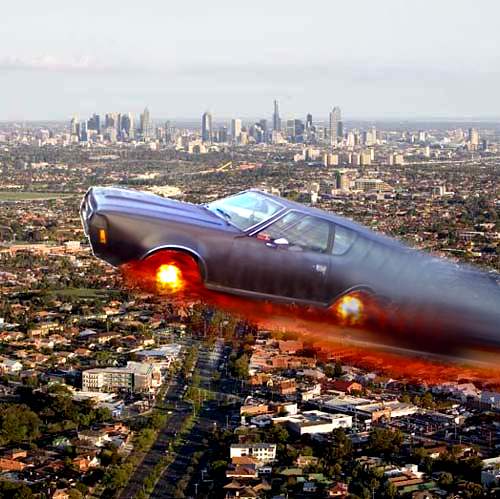
Now, don’t get me wrong, I don’t want people to think that my life has been a huge disappointment, but as I look ahead at the approaching decade when I spend the next ten years in my 50’s, I just want to say, “Dang, where’s my rocketcar?”  If there’s a general melancholy of people from my generation, it’s probably because we all grew up with the expectation that long before now we’d all have our own personal spaceships to zoom around in. 

It doesn’t matter how infeasible this idea is – even if Ford or Toyota were able to crank out little flying cars that we could all afford without selling a kidney, we’d still all end up crashing into each other at lethal speeds; egad, people can’t even figure out how to navigate the new roundabout in Athens and it comes with signs painted on the ground.  Nonetheless, I think most people my age had the genuine expectation when we were kids that by the time we reached adulthood, we’d all have The Jetson’s spacecar hovering in our driveways (or, at the very least, a James Bond style backpack in our closet that we could strap on and whoosh off to work).

Perhaps it’s my generation’s disappointment over the flying car that has tarnished how we feel about the “gee-whiz” technology that really has come along during our lifetimes.  Back in the 70’s when I was in junior high, none of us would have imagined that someday we’d all be carrying around phones the size of candy bars that we could use not just to call anyone from anywhere but that we could also use as portable jukeboxes, video cameras, calculators, newspapers, encyclopedias, cookbooks, mail-order catalogs, flea markets, game arcades, and global positioning units (and I’ll stop there, currently more than a quarter of a million iPhone apps are now available from Apple’s iTunes store).  And yet, even with this amazing cornucopia of technology at our fingertips, people my age are still not overly excited by it because, when you get right down to it, we’re not going to be satisfied until we get the flying cars we were promised when we were seven.

And now, youngsters, lean in closer because I’m going to tell you a secret.  My generation’s dissatisfaction with technology goes well beyond our disappointment over the whole flying car business due to something dreadful that happened to us back in the 1980s.  As young adults, everyone who is close to my age learned to mistrust the bright promise of new electronics when in mass, (almost simultaneously) every single one of us was made to feel like an idiot because we could not get our VCRs to stop blinking 12:00.  I have no hard data to back up this theory, but I imagine vast fortunes were created for the lucky individuals who invested in all the duct tape the rest of us used to cover up that relentless, blinking 12:00, 12:00, 12:00.

And now it can be told; the younger generation can know my generation’s deepest, darkest secret: duct tape doesn’t just fix everything, it also hides our shame.  For those of you who grew up in the 90’s and who wondered why every VCR you ever came across at the Goodwill store had a little patch of grey tape over where the clock should be, now you know: that endless blinking 12:00 wasn’t just a green LCD version of Chinese water torture, it was an entire generation’s refusal to admit that we actually needed that manual we threw away when we first opened the box.

Don’t be surprised, Dear Readers, if I’m not here next week; it’s only a matter of time before the AARP sends out one of their Death Squads to deal with me for finally revealing the whole blinking VCR secret to the younger generation.  I only hope when their thugs do arrive that I have the stamina to outrun their Hoverrounds®. 

Notice, by the way, how insidious the manufacturers of these scooters were in naming their motorized chairs “The Hoverround.”  They don’t hover.  They roll around on wheels.  Do you see what I mean?  Some dreams just won’t die even if we do.

When I’ve finally shaken off this mortal coil and drawn my last breath, if by some miracle I find myself on the right side of The Pearly Gates, I hope no one is offended when I tell them that I don’t want a pair of angel wings.  I want a Jetsonmobile!  Zoom! Zoom! Amen!

Olivia says:

I'm not going to lie, Dad.  I wish you had a flying car too. 

And also, I feel your loss, but perhaps on a smaller scale.

Ellie use to watch the Disney channel a lot when we were younger.  I would join her mostly for the movies.  Ellie loved a movie called Zenon: Girl of the 21st century.  There was a sequel too, I think.  (Wiki-research informs me that there was a third one too.  Ellie, did you know about this??)

Anyway, Zenon always gets into these space hijinks. And we all know space-hijinks are the best.  She wore cool space clothes, and her bedroom on the space station was extra cool because it was built not only for convenience but for practicality so everything had a cool compartment.  This is pretty much all I remember about this film. 

But the reason why I feel robbed is that I can no longer just enjoy technology aesthetically.  I can't look at ridiculous space shoes and think, "That's just cool."

Not that there was any effort to include realism, but Zenon's world was set in 2050.  And having seen 2010, I have different expectations.

Even watching Minority Report, which is among my favorite films, I notice techology flaws and suddenly I'm less impressed.  At least a little bit.

Sigh.

By the way, you crack me up, as always. 

#6 The Future - Olivia


Look, I'm no fortune teller.  

Let's make that clear before we go on.  In the event that what I say comes across as a prediction within the length of this post, I want you to remember the first sentence.  I'm no fortune teller.  I'm also definitely not Carl Sagan or Stephen Hawking.

Besides, trying to describe the deep future is like watching pro-wrestling.  Deeply entertaining, but you must remind yourself it's all talk.  It can be heartbreaking to watch those who still believe.  

We live in 2010.  

We're barely ankle-deep in this century, if you think about it.  I don't believe anyone thought it would be this way when we were this far in the last century.

Even the 30's, 40's, and 50' were pretty sure we'd have some kind of contact with aliens by now, at least in more of a Roswell, New Mexico kind of way than a state of Arizona way.

Antiquated 1950's pop culture totally had no idea that kids would still be wearing rolled-up skinny leg jeans.  And I'm sure there are those who are slightly disappointed that their life isn't a little more space suits and a little less track suits. 

Or those who are even further bummed that things don't fly, teleport, or in general, include more lasers.  My dad may even be numbered among them.  

We still like to play Nostradamus though.  

But instead of trying to predict what the next day will hold, perhaps we should spend more time on how today will look when it's being examined as the lens of yesterday.  How that snapshot will develop is the closest thing we have to genuine prediction.  

My communications professors, the ones that always try to keep us young spunky things on the constant cusp of a the new era in media, like to remind us that the first cars looked a lot like the buggies that require horses.  They say this to suggest that the next big thing may look very much like what we have, but with a slightly different spin.  We go off of what we already have.  

Or, if you are going to paint the future, go crazy.  

Even in late 2008, Flight of the Conchords would sing, "The distant future, the year 2000 ..." before ripping into a killer binary solo.  

And the late great Conan O'brien show use to have a sketch where they would delve into the "future," always beginning with, "In the year 2000 ... " Classic. 

Dream big.  That or, like they say in Back to the Future, make like a tree and get out of here.  

What've you got to lose?

You can't say anyone predicted the likes of Lady Gaga.  
Or the popularity of string cheese.  

I just hope they still have dance parties in the future. 

Don Replies:

I really like the phrase "ankle-deep in this century."  It's both visually descriptive and metaphorically accurate;  a lot of times I feel like we're going through this new century as though we stepping in something sticky and unpleasant.  Perhaps that's why in writing about the future, the both of us took a bit of a nostalgic approach to it.  Writing at the dog's tail of of this decade (okay, that's not "ankle-deep" but I'm trying), I wonder if people 50 or 100 years ago were more optimistic about their future or if that's just they way we imagined them.  Either way, optimism about what's coming down the road seems old-fashioned and a bit corny like an old 78 rpm record scratching its tune through the giant horn of a Victrola. 

I think there was a time in the past when a lot of people felt that innovations in science and technology would eventually lead us to a better life.  And perhaps it has.  Aggro-science is producing more food than ever. People are living longer now, and you do not hear a lot about kids getting crippled by polio or babies dying from the measles.  On the other hand, most of us have seen at least one of the Terminator movies, and I don't think as a whole, society has the confidence it once had in the basic benevolence of scientists.  We've seen too much of corporate greed and what can happen when callous executives order the dumping of chemical waste. Furthermore, it would be hard to name a new technology of the last 50 years that wasn't appropriated by the military to help them kill people who get in their way.

So now instead of movies depicting funny and eccentric scientists who create flubber or who comically shrink their children to the size of pocket change (only to restore them with no harm done just before the credits start to roll), we get insane movie scientists who release superbugs that kill off 99% of the population and turn us into brain chewing zombies.  Or even worse, we get crazy surgeons who sew their kidnap victims into giant human bugs.  Even real life scientists sound scary crazy when they start talking about micro-circuitry the size of blood cells that uses artificial intelligence to adapt itself for its own autonomous purposes.  I can't predict what the next 50 years will bring, but without my rocketcar standing by to make a hasty getaway, I'm not sure I'd want to be around for all of it anyway.

Monday, August 30, 2010

#5 Kitsch - Olivia


I have often pondered life without Garfield, the cat.

Without the fat, orange, sarcastic feline with an inclination for waking up in lasagna pans, where would we be?  And if not Garfield, what would take his place?  Would some other mildly asinine creature crawl out of mid-western obscurity?  Or would it be something else, a mineral or vegetable?

Or is Garfield the cat the merciful option compared to whatever might replace him in this alternate reality?  We may never know.

Without Garfield, Jon would probably date more at the very least.  A man who let's his cat talk back to him and eat all his Italian food translates to a red flag in my book.  Then again, even without Garfield, Jon may still have some problems ...

And yet, I think we may need Garfield.

I think Garfield officially became kitsch when he started showing up in plush form, suction cupped to the back window of station wagons.  Or maybe it was when he started popping up on t-shirts as an icon to the phrase "Not My Problem."  Either way, he has most joined the ranks of all that could be considered campy, washed up, or cliché.

Kitsch is bad taste, but harmless.  Kitsch has good intentions, but perhaps misguided execution.  Kitsch is iconic for all the wrong reasons.

Kitsch is, in essence, the Fig Newton.

However, despite being the weeds in the garden of pop culture, kitsch-y things still have their  place under the sun.  And I do mean besides fodder for irony and ridicule.

The kitsch item is often a ripple, a reaction to a bigger, stronger, more influential and probably more sophisticated idea.  It draws our eye to what is really shaking us up while we look at the cultural pop-ups in it's wake.

I'll be honest, I have no idea what ever made Garfield culturally relevant.  Please, don't tell me it's because he's funny.  Maybe someone else can ponder that one.

But I can tell you about what is on the rise, and we all know that what comes up, must come down: Twilight.

I don't want to get too deep into this because sometime next year, I'm going to write a whole post on vampire culture, but it is a prime example.

It seems that there is a cultural fixation with the un-dead in general, but especially within the realm of gentlemen blood-suckers.  Are girls attracted to their scruples?  Their cold, rock-hard bods?  The sparkles?  Probably all of the above.  But that alone is not enough for what we have here, as in cultural kudzu.  All of those things secretly spell out some kind of decent stability.  Even the sparkles of his perfect vampire skin will glimmer in sun exposure every time.  And frankly, in this national climate, stability in any form has never looked better.

But the fanaticism won't last forever, even if in theory, Edward's chiseled features could.  Even if he doesn't age, we do.  The masses bore quickly.

Twilight fans, you know your day is coming, if it is not here already.  Someday, your vampire swag will no longer be hot (cold?) and it'll crowd yard-sale tables for years to come.  That or you'll have to store it in a closet or attic, right next to your Beanie Baby collection.  But don't worry, someone will buy it.

That's what makes it kitsch.

Don replies:


After reading your post, I was left wondering which is more pathetic: Jon without Garfield or Bella without Edward?  I'd guess that while both Garfield and Twilight have their fans, what's really interesting is how vocal the people are who are not their fans.  


I'm mean, most often when people don't care for something arty or literary (okay, okay, I may be stretching the terms "arty" and "literary" here), they just ignore what they don't like in favor of spending time with other material they do like.  After all, no one is making anyone read/watch Garfield or Twilight (at least not yet; perhaps in a few years Twilight might become required reading after the coming apocalypse and it's discovered that reading the sparkling vampire series is the best method for doing serious penitence and ridding oneself of some seriously bad karma).


People who don't like Garfield and/or Twilight, however, don't just smile politely and step aside while they see you reaching for the DVD version in the video store, they'll point you out and try to shame you right then and there.  It's not enough that they don't enjoy cynical cartoon cats or whiny self-absorbed vampires, they don't want anyone else enjoying them either.  


I'm not a big fan of neither Garfield nor Twilight, but as a big fan of greasy, ready-made gas station cuisine, I feel a twinge of sympathy for those people who do like either one and feel they risk becoming social pariahs merely by letting others know their secret (albeit unfathomable) pleasure in their reading/viewing choices.  If someday soon a hybrid Garfield/Twilight book comes out (you know like the immensely popular Pride and Prejudice and Zombies), I only hope I can be well out of town when the screaming and crying begins at the bookstores as people line up to buy the book and another line forms to smack those people in the face for buying the book.


It might be because I've been thinking a lot about this topic this week, but kitsch seems to be increasing at an exponential pace.  How long, I wonder, before everything we watch, read, or listen to begins to emit that faint whiff of cheddar?  Okay, enough said.  Time to go listen to The Beatles; a sure cure for overcoming kitsch saturation (unless, of course, "Piggies," "Yellow Submarine," or "Octopus's Garden" happens to pop up in the mix, and then, dag, it's back to square one).

Sunday, August 29, 2010

#5 "Kitsch" -- Don


“Happiness is a thing called Joe.” –  Yip Harburg (1940)
“Happiness is a warm puppy.” – Charles Shultz (1962)
“Happiness is a cigar called Hamlet.” – the Collett Dickenson Pearce Agency (1966)
“Happiness is a warm gun.” – John Lennon (1968)


For the record, by the way, Bill Watterson, the cartoonist who wrote and drew Calvin and Hobbes, never once had Calvin peeing on anything, ever.  The ubiquitous sticker decals that we see on cars and trucks comes from an unauthorized, unapproved, plagiarized reproduction of Calvin from a strip in which the boy had his back turned toward the reader while he filled a water balloon.  Someone, somewhere in the back alleys of commerce, took the image, scanned it (or redrew it), and added the contextual urination.  The irony of how popular these “Peeing Calvin” decals have become is that Watterson has always adamantly disproved of any commercial usage of his comic strip characters and, despite offers ranging well into millions of dollars, refused to sell his work for use in advertising because he felt merchandizing Calvin would have corrupted the artistic integrity of the strip. 

At first, Watterson sued a few decal manufacturers for copyright infringement, and they altered the appearance of the boy to look a bit different from Calvin.  Unfortunately, because they are so many people willing and able to pirate the original pirates, so many businesses are now hawking these decals that there is no way Watterson can go after them all for infringing on his rights to his own creation.  In one interview, Watterson said, "I clearly miscalculated how popular it would be to show Calvin urinating on a Ford logo." 

And, of course, now Calvin wees on everything, not just carmakers.  Last April, U.S. District Judge Malcolm J. Howard ruled that an ex-Marine working at a military base was wrongly disciplined by base commanders for displaying a decal of Calvin peeing on a cartoon portrayal of Muhammad.  

Whatever Calvin is urinating on – regardless whether it’s somebody else’s favorite carmaker, sports team, or religion – I find the whole business trashy.  And this, of course, leads me into this week’s topic of “Kitsch.”  For those who may be unfamiliar with the term, “kitsch” is any type of art that’s made up of some combination of whatever is lowbrow, vulgar, mass-marketed, and aimed at the lowest common denominator.  Kitsch is frequently excessively sentimental, inordinately patriotic, or inappropriately titillating. 

As far as I am concerned, precisely delineating “what is” and “what is not” kitsch is beyond the ability of any particular individual because ultimately where the line gets drawn between art and garbage is based solely in the personal taste of each and everyone of us.  I have no idea how many trailer parks there are here in the US, but I would gamble for every trailer park, there has to be at least three paintings of Elvis on a velvet canvas.  If I had a time machine, I think I would go back to the early 1950’s (when Elvis was just another poor hillbilly from the sticks) and bribe the future King of Rock and Roll to get a tattoo that said “Velvet” just to see how high it would register on my Acme Irony Meter.

Saying that kitsch can’t be precisely defined, however, is not the same thing as saying it doesn’t exist.  In 1964, Supreme Court Justice Potter Stewart wrote in a case dealing with obscenity that while hard-core pornography may be hard to define, “I know it when I see it.”  I would say the same is true for kitsch.  Though we may argue over whether any particular work of art or music is kitsch, I don’t see how we could argue whether or not the category (or genera, perhaps) exists.  Anyone who would argue there’s no line at all between real art and kitsch has never been to a county fair.  County fairs – with their generous heart-choking deep-fried cuisine, their ear-splitting midway Country music, their peculiar “animal or machine versus gravity” sporting events, their cartoon-themed amusement prizes, and their meager-toothed patrons sporting all-encompassing tattoos – represent the absolute nexus of kitsch.

Don’t get the idea from all I’ve said so far, by the way, that I’m somehow “anti-kitsch” – because I’m not.  Despite the 8 years in graduate school I spent obtaining a Ph.D, I’m still a hillbilly.  Given a choice between brie and Velveeta, you know which one I’m going to go for, right?  (And at the risk of being too blunt about it – lest I set off the alarms that puts me on the radar of The Illuminati – you and I both know there is a cosmic relationship between the “Elvis on Velvet” and the Kraft “Velveeta.” This is no coincidence; it’s a conspiracy.)

In 1958, Sheb Wooley had a #1 hit with the song “Purple People Eater”; it came in at #3 for the year, putting “All I Have to Do is Dream” by The Everly Brothers at #4.  Now, in my humble opinion, The Everly Brothers were one of the finest musical acts of all time, and “All I Have to Do is Dream” is one of their finest compositions.  Just because Sheb Wooley outsold them in 1958 doesn’t really indicate much.  I don’t really dislike “Purple People Eater.”  There are times when (at a Halloween party, for example) it is exactly what I would want to listen to. The point I’m trying to make, however, is that what is most popular isn’t always the most artistically substantial.  In fact, as rule of thumb, it’s almost always the inverse: given the cultural tastes of humans in general, what is most popular is typically going to be the most atrocious, vulgar, or banal.

In regards to the question in the image that illustrates this post, The Campbell’s Tomato Soup Can is a painting (or more accurately a silk-screen) by Andy Warhol.  Back in 1962, Warhol did a series of paintings based on sketches he did of ordinary Campbell soup cans and their labels.  At his first one-man-show gallery exhibit of the soup cans, Warhol sold a total of six canvases (out of 32) for $100 dollars each (Actor Dennis Hopper was, strangely enough, one of those six people who plunked down a Benjamin to take one of those bad-boys home).  Skip ahead over 40 years,  and in 2006, the last time a Warhol Campbell’s Soup Can painting went up for public auction, it sold for $11.8 million, and that painting (Small Torn Campbell’s Soup Can -- Pepper Pot) wasn’t even one of those original 32 paintings that were selling for $100 each on their opening night at the gallery.

This is why I can honestly say I don’t understand anything about “real” modern art.  If these paintings were kitsch when you could buy one for $100, then are they still kitsch if they sell for more than $12 million dollars today?  Is there a relationship between financial value and aesthetic value?  I honestly do not know how to answer these questions.  Who gets to decide what is and isn’t “fine art”?  Who gets to say what is and isn’t “kitsch”?

I don’t know who has the authority to answer these questions, but I know it’s not me.  Like most people, I suppose, I have my opinions on what makes something “art” but these opinions are never going to be anything more than just that, my opinions.

I’d like to argue (for example) that the 1960’s Batman tv series of my childhood (starring Adam West) was pure kitsch while the latest Batman movie, The Dark Knight (starring Christian Bale), was not.  While I’m a big fan of both, I think the artistic sensibility of the later crosses from mere pop culture into the realm of real art while the former does not. I am also a big fan of Tim Burton’s Batman (released in 1989). And this movie stumps me. I don’t know if Burton’s version should be considered kitsch or not.  Another of Burton’s other early films Pee Wee’s Big Adventure is clearly kitsch, a massively-entertaining juggernaut of a movie but kitsch nonetheless.

If anyone wants to straighten me out on this, you are more than welcome to leave comments below.  If not, I guess I’ll see you next week.


Olivia says:


First of all, in response to Mom, I do not think the Dinosaur song is kitschy.  It’s far too cool for that.  Also, I think for something to something to truely be kitsch-worthy it has to have gained some unexplicable popularity, which, besides in the lucky few who have heard it, has yet to be achieved.  


That said, you bring up some true points.  


I wonder what creators of things that end up to be kitsch think about their creations.  What I mean is, what do you think Elvis would think about his likeness in velvet?  Do you think Sheb Wooley would look back at that song in wonder or nausea?  


In response to your question, the only relationship I can think of between financial and aesthetic value is one of supplanting one for the other.  When someone chooses something obliviously to mimic prestige, I think you’re on the road to kitch, e.g. glass figurines make your living room look ‘fancy.’  Trust me, it’s not going to do it.  


However, I think there are inbetween-y things.  I kind of wish I had a kitsch-o-meter sometimes.  Because I have no idea what to think about Pee Wee’s Big Adventure except that it’s flawlessly awesome.  


But I guess, like you suggested, kitsch is in the eye of the beholder.  


Also, please explain to me what is up with those naked babies that look like they’re giving eachother bedroom eyes???  Where did THAT come from?